 Call Us :- 08071930600
 Send Inquiry
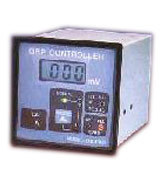
Dual Limits ORP Controller with Iso 4 20mA Tx Outp
Product Details:
- Pressure Up to 6 bar
- Connection BNC input for Electrode, terminal blocks for outputs
- Accuracy 2 mV
- Function Dual Limits ORP measurement and control
- Size 96 x 96 x 110 mm (Panel Mount)
- Click to View more
X
Dual Limits ORP Controller with Iso 4 20mA Tx Outp Product Specifications
- 96 x 96 x 110 mm (Panel Mount)
- 2 mV
- Up to 6 bar
- Dual Limits ORP measurement and control
- BNC input for Electrode, terminal blocks for outputs
- 0C to 50C
- 2 x SPDT, 5A/230VAC
- 230VAC/50-60Hz
- ABS plastic housing
- Panel Mount
- Compatible with standard ORP electrodes
- LCD digital display
- Automatic/manual (optional)
- Isolated 4-20 mA Transmitter Output
- Two independent relay setpoints
Product Description
We are providing a unique series of Dual Limits ORP Controller with Iso 4 20mA Tx Outp. It is integrated with adjustable multiplier. This range is designed in an accurate ph display. It has a dual time relay with bright red Led display system. Dual Limits ORP Controller with Iso 4 20mA Tx Outp is designed in a pleasing aesthetics with membrane selector switches. It is panel mounted size instrument which indicates pH when attached to a pH electrode.
Specification
| Display | 3 Digit LED 0.56 character height |
| Range | -1999mV to +1999mV |
| Calibration Zero Adjust | Range 30mV |
| Set Limits | 0 to 1999mV for Oxidation/Reduction |
| Accuracy | 0.5% 1 Digit |
| Input Impedance | >1012 |
| Tx. Output | 4-20mA isolated for 0-1999mV |
| Relay Logic | Reduction Relay ON for ORP > Set Limit |
| Front Panel | a. One membrane switch to press and read Oxid. Limit |
| Supply | 110V/220V AC 10% @ 50/60H |
| Size | Front facia 96mm x 96mm |
| Weight | 800 grams |
Advanced Monitoring and Control
This controller offers dual setpoints for independent relay operation, supporting sophisticated process management. Its two SPDT relays handle up to 5A at 230VAC, making it suitable for complex automation and fail-safe applications. The large, easy-to-read LCD display ensures operators can quickly assess system status and respond as needed.
Versatile Integration and Compatibility
Equipped with an isolated 4-20 mA transmitter output, the device can interface smoothly with most monitoring and control systems. The BNC input supports standard ORP electrodes, and terminal blocks make wiring straightforward. Compact panel-mount design (96 x 96 x 110 mm) fits seamlessly into control panels.
Durable Construction for Demanding Environments
Housed in robust ABS plastic, this controller withstands pressures up to 6 bar and temperatures from 0C to 50C. Automatic or manual temperature compensation (optional) ensures stable, accurate readings, with accuracy up to 2 mV, ideal for industrial and laboratory settings.
FAQs of Dual Limits ORP Controller with Iso 4 20mA Tx Outp:
Q: How is the Dual Limits ORP Controller installed and connected?
A: The controller is designed for easy panel mounting with a compact 96 x 96 x 110 mm footprint. Its BNC connector allows quick connection to standard ORP electrodes, while terminal blocks simplify wiring for relay outputs and the isolated 4-20 mA transmitter.Q: What are the main functions and benefits of having dual setpoints?
A: Dual setpoints enable independent relay control, providing flexible options for automationsuch as activating alarms, dosing pumps, or safety shutdowns. This enhances process reliability and allows precise management of oxidation-reduction potential within a desired range.Q: When should temperature compensation be used, and how does it work?
A: Temperature compensation is important when ORP readings may be affected by temperature fluctuations. This model offers both automatic and manual compensation (optional), ensuring that readings remain accurate despite environmental changes, thereby optimizing process control.Q: Where is the Dual Limits ORP Controller typically used?
A: This controller is commonly deployed in water treatment plants, industrial processing, chemical manufacturing, and laboratory environmentsanywhere precise ORP monitoring and dual-action control are required for safety or process efficiency.Q: What safety features are included with this ORP controller?
A: Safety is enhanced by two independent SPDT relays rated at 5A/230VAC, which can be used to trigger alarms, shutdown systems, or actuate other safety devices. The isolated 4-20 mA output minimizes interference and ensures stable data transmission.Q: How does the controller connect with external monitoring systems?
A: The instrument provides an isolated 4-20 mA output, compatible with SCADA, PLC, or data loggers. This isolation helps protect connected equipment and maintains signal integrity during process communication.Tell us about your requirement

Price:
Quantity
Select Unit
- 50
- 100
- 200
- 250
- 500
- 1000+
Additional detail
Mobile number
Email

Other Products in 'PH & ORP Indicators Controllers' category

Contact Details

- 3/1/29 FF, SITE-IV, SAHIBABAD,Ghaziabad - 201010, Uttar Pradesh, India
- Phone : 08071930600
COUNTRONICS
Ghaziabad, Uttar Pradesh, India
Ghaziabad, Uttar Pradesh, India

- Mr. Dinesh K. Gupta (CEO)
- countronindia@gmail.com

|

 Send Inquiry
 Send SMS
 Call Me Free
COUNTRONICS
All Rights Reserved.(Terms of Use)
Developed and Managed by Infocom Network Private Limited.
Developed and Managed by Infocom Network Private Limited.

